Unesco heritage sites in Slovakia
The United Nations Educational, Scientific and Cultural Organisation (UNESCO) World Heritage Sites are places of cultural and natural importance, preserved as heritage.
As of 2026, Slovakia has 8 World Heritage Sites. Three of them are transnational and shared with other countries: the Caves of Aggtelek Karst and Slovak Karst are shared with Hungary, the Danube Limes is shared with Germany and Austria, and the Ancient and Primaeval Beech Forests of the Carpathians and Other Regions of Europe are shared with 17 other countries.
1. Historic Town of Banská Štiavnica and the Technical Monuments in its Vicinity
This Historic Town is an outstanding example of an important mining settlement that has developed since the Middle Ages. The site is a unique testimony to how mining wealth shaped both an entire town and its landscape. Its water management system was the most advanced of its kind until the 19th century, and its Mining Academy helped train generations of European mining experts — making it a landmark in the history of technology and industry.

2. Levoča, Spišský Hrad and the Associated Cultural Monuments
Very few complete medieval towns and castle complexes have survived Europe's centuries of rebuilding and destruction. This site is a rare exception: a hilltop castle, walled town, and religious sites — all built by Saxon settlers — preserved together as one intact medieval world, giving a rare, complete picture of how a town, its rulers, and its church once functioned as a whole.
_1.png?1790928390626)
3. Vlkolínec
Vlkolínec is the best-preserved and most complete example in the region of a traditional Central European mountain village — its layout, wooden houses, and surrounding farmland have survived almost unchanged since the 19th century, offering a rare, intact picture of how such rural communities once lived and worked.
_1.png?1790929020736)
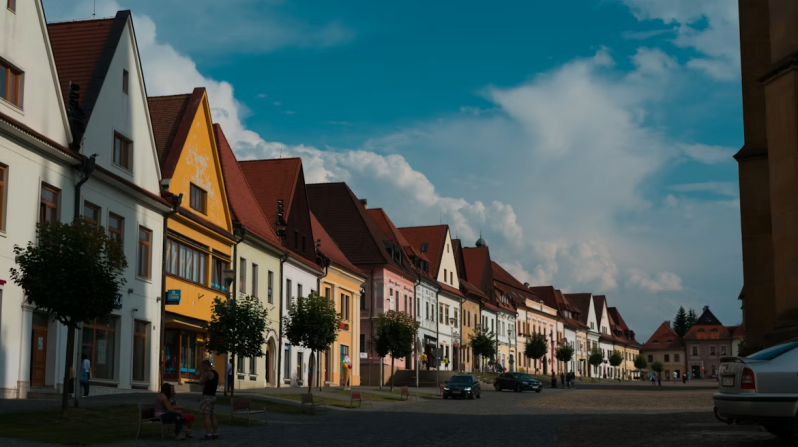
4. Bardejov Town Conservation Reserve
Here you can see what a real working medieval trading town looked like — physically and socially — something that's extremely hard to find anywhere else. Its market square, merchant houses, church, town hall, and defensive walls have stayed largely as they were built. Alongside this, its Jewish quarter — with a synagogue, ritual baths, and other original buildings — shows that the town wasn't just prosperous, but also home to a diverse, multicultural community.
_1.png?1790929050523)
5. Wooden Churches of the Slovak part of the Carpathian Mountain Area
In most of Europe, religious architecture was shaped by a single dominant faith, and few wooden church traditions have survived intact. Here, in one small region, three very different faiths built side by side using the same wood-building tradition, each adapting it to their own rites — Latin, Protestant, and Byzantine. The religious diversity and tolerance expressed through a shared building tradition — something almost unique in Europe.
_1.png?1790929089519)
6. Caves of Aggtelek Karst and Slovak Karst*
Karst caves are common worldwide, but rarely do so many different types — stream caves, vertical shafts, ice-filled caves — occur together in one small, well-preserved area. Their sediments and rock formations record tens of millions of years of climate history, preserving rare evidence of both ancient tropical conditions and later Ice Age freezing side by side. The caves also shelter over 500 species adapted to life underground, some found only in these caves.

7. Ancient and Primaeval Beech Forests of the Carpathians and Other Regions of Europe*
After the last Ice Age, beech trees survived only in small refuge pockets in southern Europe, then spread naturally across the continent over the past 11,000 years — a process still happening today. These forests are living evidence of that expansion, showing how one tree species adapted to vastly different climates and landscapes, from coastal areas to mountain treelines. They also preserve rare old-growth habitat and genetic diversity essential for countless dependent species, largely free from human disturbance.

8. Frontiers of the Roman Empire – The Danube Limes (Western Segment)*
For over 400 years, this frontier marked the edge of Roman civilisation against the peoples beyond it, and its remains still show, in unusually complete detail, how Rome projected power far from its capital. The sites reveal how military strategy adapted over centuries to shifting threats, how defensive outposts grew into thriving towns, and how Roman culture — religion, architecture, trade — spread and took root at the empire's furthest edge. Many of these Roman settlements later formed the seeds of medieval and modern towns along the Danube, making the frontier's legacy still visible in the region today.
.png?1790929302272)
Photo author: Jaroslava Schmidtová
URL: whc.unesco.org/en/documents/173016